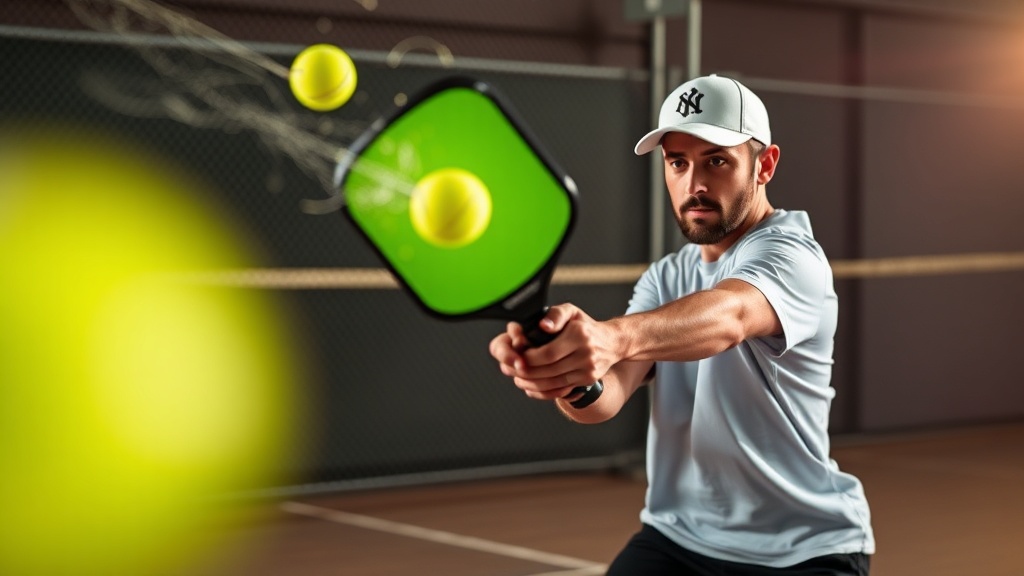
Develop Explosive Rotation for More Powerful Pickleball Shots

Why Does Rotational Power Matter More Than Arm Strength?
Here's something that surprises most recreational players: approximately 55% of the force behind a high-velocity pickleball drive comes from your hips and trunk—not your arm. When you watch professionals unleash blistering forehands, you're witnessing kinetic chain sequencing at work. The power starts in the ground, travels through the legs, amplifies through the core's rotational muscles, and finally releases through the shoulder and wrist. Skip the rotation—and you're basically trying to drive a nail with a rubber mallet.
This article covers how to develop rotational power specifically for pickleball's unique demands. We're talking about the kind of explosive twisting force that transforms your third-shot drives from predictable floaters into weapons opponents actually fear. You'll learn to identify rotational weaknesses, implement targeted training protocols, and integrate these movements into your court time. No fluff—just practical mechanics that transfer directly to faster shots and better court coverage.
What Is the Kinetic Chain and How Does It Work in Pickleball?
Think of your body as a whip. The handle moves first—slow and controlled—building energy that amplifies as it travels toward the tip. In athletic terms, this is called proximal-to-distal sequencing. Your large, stable core muscles (the proximal segment) initiate rotation while your smaller limb muscles (the distal segment) channel that energy into the paddle.
Pickleball rewards players who understand this sequence. A proper forehand drive begins with hip rotation toward the net, followed by torso twist, then shoulder uncoiling, and finally wrist snap. Each segment accelerates then decelerates—transferring momentum upward like a wave. When this chain breaks down—say, by using only your arm—you sacrifice both power and consistency. You're also inviting shoulder and elbow injuries that'll bench you for weeks.
The rotational demands in pickleball differ from tennis or golf. You're closer to the net, reaction times are compressed, and you rarely have perfect setup time. Your training needs to reflect these constraints—focusing on rapid, reactive rotation rather than slow, maximal-effort windups.
How Can You Tell If Your Rotation Needs Work?
Several telltale signs indicate rotational deficiencies. First, check your follow-through. If your paddle finishes across your body with your chest still facing sideways, your trunk isn't rotating fully through the shot. You're leaving power—quite literally—on the table.
Second, listen to your shots. Arm-dominant strokes produce a hollow "thwack" with limited penetration. Rotationally-driven shots sound crisp and authoritative, carrying deeper into the court with less perceived effort. Third, monitor your fatigue patterns. If your shoulder and elbow tire before your legs and lungs during long rallies, you're over-relying on small muscles that aren't designed for sustained power production.
Here's a quick self-assessment: stand with feet shoulder-width apart, hold your paddle across your chest, and rotate your torso as far as possible in each direction without moving your hips. If you can't achieve at least 45 degrees of rotation, or if one side feels dramatically restricted, you've found your bottleneck. Research on rotational athletes confirms that limited thoracic spine mobility directly correlates with reduced power output and increased injury risk.
What Exercises Build Pickleball-Specific Rotational Power?
Effective rotational training combines mobility work, strength development, and power expression. Skip any of these three components and your results suffer. Here's the progression that actually works:
Phase One: Unlock the Hips and Thoracic Spine
Before adding load, you need adequate range of motion. The 90/90 hip switch is money here—sit with both legs bent at 90 degrees (one in front, one behind) and actively rotate your pelvis to switch positions without using your hands. Perform three sets of ten switches daily. For thoracic mobility, try open books: lie on your side with knees bent at 90 degrees, arms extended forward, then rotate your top arm upward like opening a book—following the hand with your eyes. Three sets of eight reps per side.
Phase Two: Build Anti-Rotation Strength
Paradoxically, learning to resist rotation builds the stability needed to express rotation powerfully. Pallof presses are the gold standard—stand perpendicular to a cable machine or resistance band, hold the handle at chest height, and press forward without letting the band pull you into rotation. Start with three sets of twelve reps per side, progressing to split-stance and single-leg variations. Studies on core stability training demonstrate that anti-rotation exercises significantly improve rotational power in overhead athletes.
Phase Three: Develop Explosive Rotation
Now we add speed. Medicine ball rotational throws against a wall are perfect for pickleball—mimicking the hip-then-shoulder sequencing of a forehand drive. Stand sideways to a wall, hold a 6-10 pound ball at hip height, rotate away from the wall (loading the back hip), then explosively rotate toward the wall and release. The ball should hit the wall just as your hips square up. Four sets of six throws per side, twice weekly.
Chops and lifts with cables or bands build diagonal power—the kind used in serves and overheads. High-to-low chops (from shoulder to opposite hip) and low-to-high lifts develop the full rotational spectrum. Keep the weight moderate and the movement controlled—three seconds down, one second up. Three sets of ten reps each direction.
How Do You Apply Rotational Training on the Court?
Drills without context are just exercise. To transfer gym gains to game performance, you need deliberate practice that reinforces proper sequencing.
The shadow swing progression works wonders. Start with exaggerated slow-motion drives—counting "one-thousand-one" during hip rotation, "one-thousand-two" during trunk rotation, and "one-thousand-three" during arm extension. Gradually compress the timing until the sequence becomes one fluid explosive motion. Do fifty shadow swings daily for two weeks and you'll feel the difference in live play.
For reactive rotation training, try the drop-and-rotate drill. Have a partner drop a ball from shoulder height to your forehand side. You must rotate explosively to contact the ball before the second bounce—driving through with hips first. This mimics the rushed rotation required when opponents attack your body or force you into defensive scrambles.
Finally, video analysis reveals what proprioception hides. Record yourself hitting drives from multiple angles. Look for hip initiation, full trunk rotation, and balanced follow-through with your chest facing the net. Compare against footage of professional players—the USA Pickleball Association's player resources include excellent technical breakdowns of elite mechanics.
Integrate these principles gradually. Start with mobility work as your warmup, progress to anti-rotation strength twice weekly, and layer in explosive medicine ball throws as your foundation solidifies. Within six weeks, opponents will comment on how "heavy" your shots feel—how the ball seems to accelerate off your paddle with a newfound authority that wasn't there before. That's the kinetic chain working as designed. That's rotational power.